
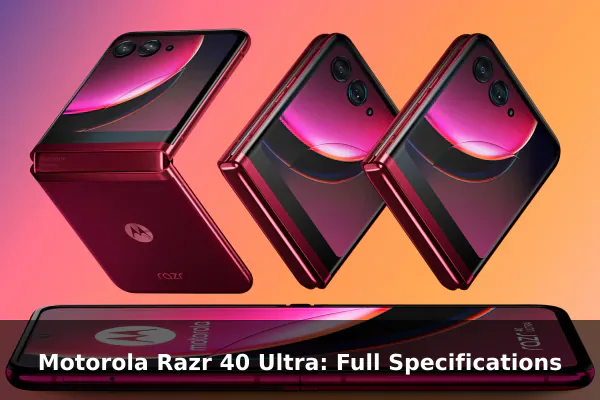
The Motorola Razr 40 Ultra, also marketed in some regions as the Razr+ 2023, is the company’s headline clamshell foldable for 2023, pairing a flagship Snapdragon 8+ Gen 1 platform with one of the largest cover screens on a flip phone at the time of its launch. Announced in June 2023, it targets buyers who want a pocketable foldable that still behaves like a full Android flagship when unfolded.
This article looks at how the Razr 40 Ultra’s specifications translate into real-world value, where it stands out among clamshell foldables, and which users it suits best. Specifications, pricing, and availability can vary by region and over time, so verify the latest details with Motorola’s official product and support pages before purchasing.
Full Specifications
Network
| Technology | GSM / CDMA / HSPA / EVDO / LTE / 5G |
| 2G bands | GSM 900 / 1800 / 1900 |
| CDMA 800 / 1900 | |
| 3G bands | HSDPA 850 / 900 / 1700(AWS) / 1900 / 2100 |
| CDMA2000 1xEV-DO | |
| 4G bands | 1, 2, 3, 4, 5, 7, 8, 12, 13, 17, 18, 19, 20, 25, 26, 28, 32, 34, 38, 39, 40, 41, 42, 43, 48, 66 – International |
| 1, 2, 3, 4, 5, , 7, 8, 12, 13, 14, 17, 18, 19, 20, 25, 26, 28, 29, 30, 38, 39, 40, 41, 46, 48, 66, 71 – North America | |
| 5G bands | 1, 3, 5, 7, 8, 20, 28, 38, 41, 66, 77, 78, 79 SA/NSA/Sub6 – International |
| 2, 5, 7, 12, 13, 14, 25, 26, 29, 30, 38, 41, 48, 66, 70, 71, 77, 78 SA/NSA/Sub6 – North America | |
| Speed | HSPA, LTE, 5G |
Launch
| Announced | 2023, June 01 |
| Status | Available. Released 2023, June 05 |
Body
| Dimensions | Unfolded: 170.8 x 74 x 7 mmFolded: 88.4 x 74 x 15.1 mm |
| Weight | 184.5 g or 188.5 g (6.53 oz) |
| Build | Plastic front (unfolded), glass front (folded, Gorilla Glass Victus), glass back (Gorilla Glass Victus), aluminum frame (7000 series), hinge (stainless steel) |
| SIM | · Nano-SIM + eSIM· Nano-SIM + Nano-SIM |
| Water-repellent coating |
Display
| Type | Foldable LTPO AMOLED, 1B colors, 165Hz, HDR10+, 1400 nits (peak) |
| Size | 6.9 inches, 107.6 cm2 (~85.1% screen-to-body ratio) |
| Resolution | 1080 x 2640 pixels (~413 ppi density) |
| Second external AMOLED, 1B colors, 144Hz, HDR10+, 1100 nits (peak) 3.6 inches, 1056 x 1066 pixels, 413 ppi, Gorilla Glass Victus |
Platform
| OS | Android 13, up to 3 major Android upgrades |
| Chipset | Qualcomm SM8475 Snapdragon 8+ Gen 1 (4 nm) |
| CPU | Octa-core (1×3.19 GHz Cortex-X2 & 3×2.75 GHz Cortex-A710 & 4×1.80 GHz Cortex-A510) |
| GPU | Adreno 730 |
Memory
| Card slot | No |
| Internal | 256GB 4GB RAM, 256GB 8GB RAM, 256GB 12GB RAM, 512GB 12GB RAM |
| UFS 3.1 |
Main Camera
| Dual | 12 MP, f/1.5, (wide), 1/2.55", 1.4µm, PDAF, OIS 13 MP, f/2.2, 108˚ (ultrawide), 1/3.0", 1.12µm, AF |
| Features | LED flash, panorama, HDR |
| Video | 4K@30/60fps, 1080p@30/60/120fps, HDR10+, gyro-EIS |
Selfie camera
| Single | 32 MP, f/2.4, (wide), 0.7µm |
| Features | HDR |
| Video | 4K@30/60fps, 1080p@30/60fps |
Sound
| Loudspeaker | Yes, with stereo speakers |
| 3.5mm jack | No |
| Snapdragon Sound |
Comms
| WLAN | Wi-Fi 802.11 a/b/g/n/ac/6e, dual-band or tri-band (region dependent) |
| Bluetooth | 5.3, A2DP, LE, aptX HD, aptX Adaptive, aptX Lossless |
| Positioning | GPS (L1+L5), GLONASS (L1), BDS (B1I+B1c+B2a), GALILEO (E1+E5a), QZSS (L1+L5) |
| NFC | Yes |
| Radio | No |
| USB | USB Type-C 2.0 |
Features
| Sensors | Fingerprint (side-mounted), accelerometer, gyro, proximity, compass, barometer (USA only) |
Battery
| Type | Li-Po 3800 mAh |
| Charging | 30W wired 5W wireless |
Misc
| Colors | Infinite Black, Glacier Blue, Viva Magenta, Peach Fuzz |
| Models | XT2321-3, XT2321-1, XT2321-2 |
| Price | $ 229.99 / £ 885.00 / € 489.90 |
Our Tests
| Performance | AnTuTu: 975461 (v9) GeekBench: 3645 (v5.1), 4045 (v6) GFXBench: 65fps (ES 3.1 onscreen) |
| Display | 1050 nits max brightness (measured) |
| Camera | Photo / Video |
| Loudspeaker | -25.4 LUFS (Very good) |
| Battery (old) | Endurance rating 83h |
Price and Availability
The Motorola Razr 40 Ultra offers a compelling combination of features and performance. While the base price is around €490, the actual cost may vary depending on your location and retailer. Below, you’ll find the approximate price of the Motorola Razr 40 Ultra converted into various currencies. Please note that these are estimates based on recent exchange rates as of June 11, 2026 and may not reflect the exact price you’ll find at a retailer.
- United States: $565
- Japan: ¥90,750
- United Kingdom: £423
- Australia: A$807
- Canada: C$788
- Taiwan: NT$17,902
- Denmark: kr3.656
- Saudi Arabia: ﷼2,120
- South Korea: ₩861,494
- Germany: €490
- Brazil: R$2.929
- Vietnam: ₫14.830.133
- Kenya: KSh 73,330
- India: ₹53,887
- Indonesia: Rp 10.130.990
- Nigeria: ₦765,368
- Pakistan: ₨157,398
- Philippines: ₱34,704
- Bangladesh: ৳৬৯,৪৫৩
Is the Motorola Razr 40 Ultra Worth It?
The Razr 40 Ultra positions itself as a premium clamshell foldable rather than a budget flip, and its hardware reflects that. With a flagship-class chipset, a high-refresh foldable main panel, and an unusually large external display, it competes directly with other top-tier flip foldables. Because foldable pricing shifts frequently and differs by market, treat any sticker price as provisional and confirm current offers through official Motorola channels.
Design and Build Quality
Motorola uses a stainless steel hinge with a 7000-series aluminum frame, Gorilla Glass Victus on the folded front and back, and a water-repellent coating for added everyday resilience. Folded, it measures roughly 88.4 x 74 x 15.1 mm and weighs about 184.5 g to 188.5 g, making it genuinely pocketable. The clamshell form factor is the core appeal here: a full-size phone that collapses to half its height.
The Standout Cover Display
The defining feature is the 3.6-inch external AMOLED with a 144Hz refresh rate, HDR10+, and Gorilla Glass Victus protection. It is large enough to run apps, reply to messages, and frame selfies with the main cameras without opening the phone. Inside, the 6.9-inch foldable LTPO AMOLED runs at up to 165Hz with HDR10+ and a 1400-nit peak, delivering a smooth and bright experience when unfolded.
Performance and Gaming
Powering the device is the Qualcomm Snapdragon 8+ Gen 1 (4 nm) with an Adreno 730 GPU, paired with up to 12GB of RAM and UFS 3.1 storage. This is a proven flagship platform that handles demanding apps and gaming comfortably; you can verify its capabilities on Qualcomm’s official Snapdragon 8+ Gen 1 page. In our testing the phone returned strong synthetic scores, indicating headroom for sustained everyday and gaming workloads.
Camera System
The dual main camera pairs a 12 MP wide sensor with OIS and PDAF and a 13 MP ultrawide with autofocus, while a 32 MP front camera handles selfies. Video tops out at 4K up to 60fps with HDR10+ and gyro-EIS. The large cover screen doubles as a viewfinder, letting you use the higher-quality rear cameras for selfies—a practical advantage unique to capable clamshell foldables.
Battery and Charging
A 3800 mAh Li-Po battery keeps the slim chassis light, supported by 30W wired and 5W wireless charging. Capacity is modest by slab-phone standards, which is typical for the compact clamshell category, so endurance will depend heavily on how often you rely on the power-hungry inner display versus the efficient cover screen.
Software and Connectivity
The Razr 40 Ultra ships with Android 13 and Motorola’s commitment of up to three major Android upgrades, which buyers concerned about longevity should confirm against Motorola’s current software-support documentation. Connectivity is comprehensive, with 5G (SA/NSA/Sub6), tri-band-capable Wi-Fi 6e, Bluetooth 5.3 with aptX Adaptive and Lossless, NFC, and multi-band GNSS positioning.
Who Should Buy the Razr 40 Ultra?
This phone is best for buyers who prioritize a compact, fashion-forward foldable that still delivers flagship performance and the most usable cover screen in its class. Those who need maximum battery endurance, a telephoto camera, or a card slot may prefer a conventional flagship slab instead.
Conclusion
The Motorola Razr 40 Ultra is one of the most complete clamshell foldables of its generation, combining a flagship Snapdragon 8+ Gen 1 platform, dual high-refresh AMOLED displays, and a genuinely useful 3.6-inch cover screen in a pocketable body. Its main trade-offs are the modest 3800 mAh battery and the absence of a telephoto lens or storage expansion. If you want a stylish, high-performance flip phone and value the large external display, the Razr 40 Ultra is an easy recommendation—just confirm current pricing, color availability, and software-update terms on Motorola’s official pages before you buy.
Official references
- Motorola official product/support pages (motorola.com) – Authoritative manufacturer source for Motorola Razr 40 Ultra/Razr+ 2023 specifications, model naming, regional variants, dimensions, display, cameras, battery, charging, colors, and box contents.
- Motorola Support – Official support hub for user guides, safety/regulatory documents, software support information, and device-specific help articles.
- Qualcomm Snapdragon 8+ Gen 1 Mobile Platform – Primary chipset source for verifying the Snapdragon 8+ Gen 1 platform and its CPU, GPU, modem, and connectivity capabilities.
- FCC Equipment Authorization Search (fcc.gov) – Official US regulator database for verifying Motorola model identifiers, radio certifications, and supported wireless bands for related Razr+ 2023 variants.
- Bluetooth SIG Launch Studio Listings (launchstudio.bluetooth.com) – Official Bluetooth qualification database for confirming Bluetooth certification details and declared Bluetooth version for Motorola device variants.
