
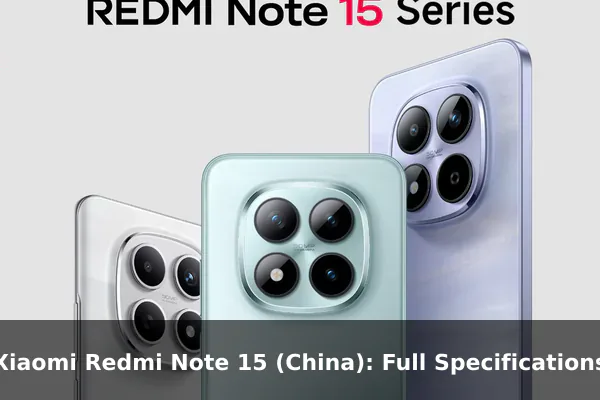
The Xiaomi Redmi Note 15 (China) arrives as a mid-range contender that leans on a familiar Redmi formula: a large high-refresh AMOLED panel, a sizeable battery, and a balanced feature set, all wrapped in a slim 7.4 mm body. Announced on 21 August 2025, it pairs Qualcomm’s Snapdragon 6 Gen 3 with Android 15 and HyperOS 2, aiming squarely at buyers who want everyday reliability without paying flagship money.
What sets this China-market variant apart is how much practicality it packs in for its class, from IP68 protection and a 5800 mAh battery to stereo speakers with Dolby Atmos and an IR blaster. The notes below break down where the Redmi Note 15 makes sense, how its hardware choices translate into real-world use, and which type of buyer will get the most out of it.
Full Specifications
Network
| Technology | GSM / HSPA / LTE / 5G |
| 2G bands | GSM 850 / 900 / 1800 / 1900 |
| 3G bands | HSDPA 800 / 850 / 900 / 1700(AWS) / 1900 / 2100 |
| 4G bands | 1, 3, 5, 8, 19, 28, 34, 38, 39, 40, 41, 42, 48 |
| 5G bands | 1, 3, 5, 8, 28, 38, 40, 41, 48, 77, 78 SA/NSA |
| Speed | HSPA, LTE, 5G |
Launch
| Announced | 2025, August 21 |
| Status | Available. Released 2025, August 21 |
Body
| Dimensions | 165 x 75.4 x 7.4 mm (6.50 x 2.97 x 0.29 in) |
| Weight | 178 g (6.28 oz) |
| SIM | Nano-SIM + Nano-SIM |
| IP68 dust tight and water resistant (immersible up to 1.5m for 30 min) |
Display
| Type | AMOLED, 68B colors, 120Hz, 3200 nits (peak) |
| Size | 6.77 inches, 110.9 cm2 (~89.1% screen-to-body ratio) |
| Resolution | 1080 x 2392 pixels (~388 ppi density) |
| Protection | Xiaomi Dragon Crystal Glass |
Platform
| OS | Android 15, HyperOS 2 |
| Chipset | Qualcomm SM6475-AB Snapdragon 6 Gen 3 (4 nm) |
| CPU | Octa-core (4×2.4 GHz Cortex-A78 & 4×1.8 GHz Cortex-A55) |
| GPU | Adreno 710 |
Memory
| Card slot | microSDXC (uses shared SIM slot) |
| Internal | 128GB 6GB RAM, 128GB 8GB RAM, 256GB 8GB RAM, 256GB 12GB RAM |
| UFS 2.2 |
Main Camera
| Dual | 50 MP, f/1.8, (wide), 1/2.88", 0.61µm, PDAF Auxiliary lens |
| Features | LED flash, HDR, panorama |
| Video | 4K@30fps, 1080p@30fps, gyro-EIS |
Selfie camera
| Single | 8 MP, (wide) |
| Features | HDR, panorama |
| Video | 1080p@30/60fps |
Sound
| Loudspeaker | Yes, with stereo speakers (with Dolby Atmos) |
| 3.5mm jack | No |
| 24-bit/192kHz Hi-Res & Hi-Res wireless audio |
Comms
| WLAN | Wi-Fi 802.11 a/b/g/n/ac, dual-band, Wi-Fi Direct |
| Bluetooth | 5.1, A2DP, LE |
| Positioning | GPS, GALILEO, GLONASS, QZSS, BDS (B1l+B1C) |
| NFC | Yes |
| Infrared port | Yes |
| Radio | No |
| USB | USB Type-C 2.0, OTG |
Features
| Sensors | Fingerprint (under display, optical), accelerometer, gyro, compass, proximity |
Battery
| Type | Li-Ion 5800 mAh |
| Charging | 45W wired 22.5W reverse wired |
Misc
| Colors | Black, White, Blue |
Value Proposition: What You Get for the Money
The Redmi Note 15 (China) is built around the idea of high perceived value. Even though no official price is confirmed in the source data, the spec sheet reads like a phone designed to undercut competitors on features per dollar: an AMOLED screen, IP68 rating, a large battery, and modern 5G connectivity are not always bundled together in this segment. For shoppers prioritizing a long feature list over raw flagship power, it is an easy phone to recommend on paper.
Design and Build Quality
Measuring 165 x 75.4 x 7.4 mm and weighing just 178 g, the Redmi Note 15 stays comfortably light for a phone with a 6.77-inch display. The headline durability feature is IP68 dust and water resistance, rated for immersion up to 1.5 m for 30 minutes, which is uncommon at this price point and adds real peace of mind. Xiaomi Dragon Crystal Glass protects the front, and the phone ships in Black, White, and Blue.
Display: Big, Bright, and Smooth
The 6.77-inch AMOLED panel runs at a 120Hz refresh rate with a 1080 x 2392 resolution (roughly 388 ppi) and a peak brightness quoted at 3200 nits. That combination should deliver punchy colors, smooth scrolling, and strong outdoor visibility. With an ~89.1% screen-to-body ratio, the front is dominated by the display, making it well suited to streaming, gaming, and general media consumption.
Performance and Software
Inside sits the Qualcomm Snapdragon 6 Gen 3 (4 nm), an octa-core chip with four Cortex-A78 cores at 2.4 GHz and four Cortex-A55 cores at 1.8 GHz, paired with the Adreno 710 GPU. This is a capable mid-range platform tuned for efficient daily use rather than sustained heavy gaming. Memory options span 6GB to 12GB of RAM with 128GB or 256GB of UFS 2.2 storage, and a shared microSDXC slot allows expansion. On the software side, Android 15 with HyperOS 2 provides Xiaomi’s current interface and feature set; for update longevity, it is best to confirm policy details against Xiaomi’s official channels.
Camera Capabilities
The Redmi Note 15 keeps its camera setup straightforward. The main shooter is a 50 MP f/1.8 wide sensor (1/2.88″, 0.61µm) with PDAF and an auxiliary lens, supported by an LED flash, HDR, and panorama. Video tops out at 4K@30fps with gyro-EIS for steadier handheld footage. Up front, an 8 MP wide selfie camera handles video calls and casual shots at up to 1080p@60fps. It is a sensible, no-frills system rather than a multi-lens showcase.
Battery and Charging
A large 5800 mAh Li-Ion battery anchors the package, promising strong endurance for most users. Charging is rated at 45W wired, with 22.5W reverse wired charging available to top up accessories. The combination of an efficient 4 nm chipset and a sizeable cell suggests comfortable all-day battery life with room to spare.
Connectivity and Extras
Connectivity is well-rounded for the segment: 5G (SA/NSA) support, dual-band Wi-Fi (ac), Bluetooth 5.1, NFC, and an increasingly rare infrared port for controlling home appliances. Audio is handled by stereo speakers with Dolby Atmos plus Hi-Res and Hi-Res wireless support, though there is no 3.5mm headphone jack. The USB Type-C port runs at USB 2.0 speeds, and an under-display optical fingerprint sensor handles security.
Who Should Buy It
The Redmi Note 15 (China) suits buyers who want a durable, media-friendly daily phone with strong battery life and a bright AMOLED screen, without needing top-tier gaming performance or a versatile multi-camera array. Power users and mobile photographers may want to look higher up the range, but for everyday productivity, streaming, and reliability, this model covers the essentials confidently.
Conclusion
The Xiaomi Redmi Note 15 (China) is a well-balanced mid-ranger that prioritizes the things most people use daily: a large, bright 120Hz AMOLED display, a long-lasting 5800 mAh battery, IP68 durability, and dependable 5G connectivity. Its Snapdragon 6 Gen 3 chip and single 50 MP main camera are pragmatic rather than class-leading, so demanding gamers and photography enthusiasts should consider stepping up a tier. For everyone else seeking a sturdy, feature-rich everyday companion at value-oriented pricing, the Redmi Note 15 is an easy recommendation—just confirm final pricing, variant availability, and update commitments through Xiaomi’s official channels before buying.
Official references
- Xiaomi China / Redmi official product page (www.mi.com) – Primary manufacturer source for China-market Redmi Note 15 specifications, variants, colors, launch pricing, dimensions, battery, display, camera, and charging details.
- Xiaomi Security Center (trust.mi.com) – Official Xiaomi source for software/security update policy and device support information relevant to OS and update claims.
- Qualcomm Snapdragon 6 Gen 3 Mobile Platform (qualcomm.com) – Primary chipset source to verify Snapdragon 6 Gen 3 platform capabilities, CPU/GPU, modem, memory, camera, and connectivity specifications.
- China Telecommunication Equipment Certification Center (TENAA) (tenaa.com.cn) – Official China certification source for approved phone model details such as network support, dimensions, battery rating, and regulatory identifiers.
- Ministry of Industry and Information Technology of China radio/network access approval (miit.gov.cn) – Official regulator source for China-market telecom equipment approvals, model identifiers, and radio/network access certification.
